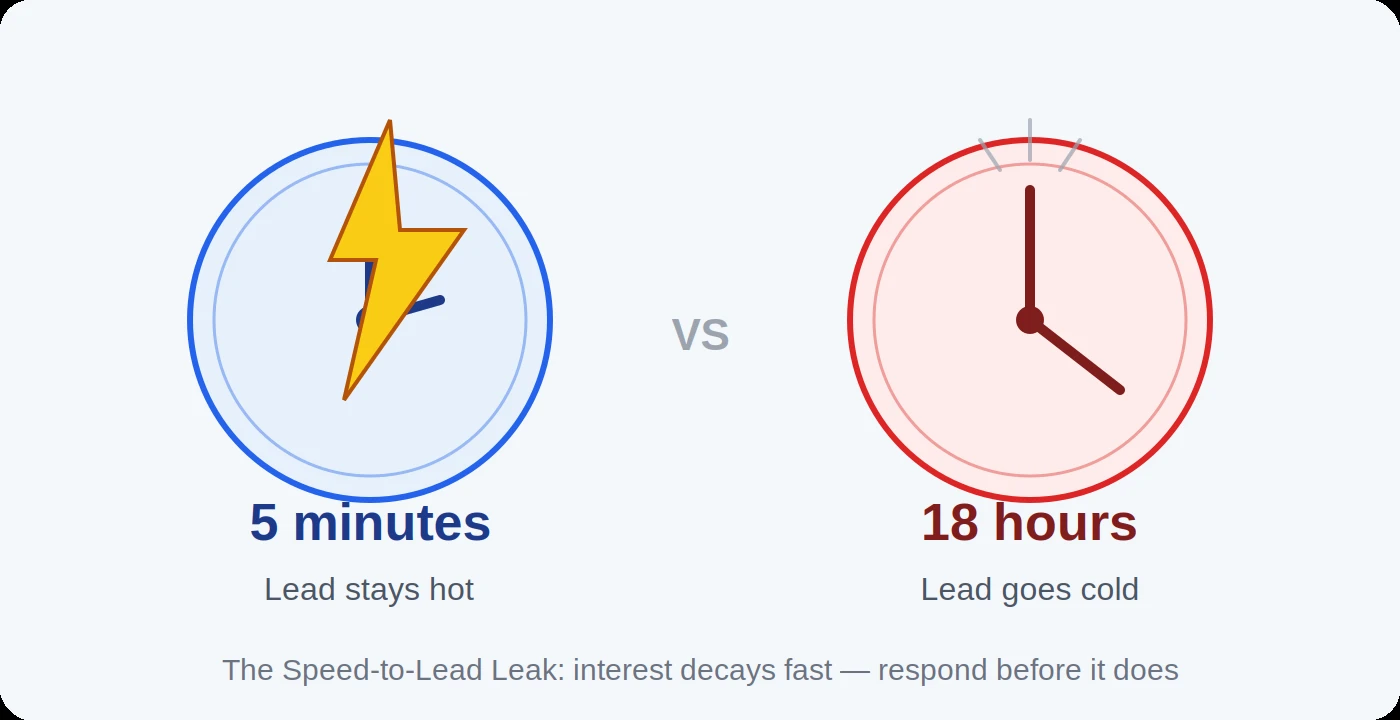
You spend thousands generating a red-hot lead. The prospect fills out your form at 2:00 PM, motivated and ready. Then your sales team gets to it the next morning — eighteen hours later — armed with a beautifully crafted pitch. By then, the prospect has cooled off, contacted two competitors, or forgotten they even inquired. You didn’t lose the deal on price or product. You lost it on the clock.
What Is the Speed-to-Lead Leak?
This is the Speed-to-Lead Leak, and the data on it is merciless. Contacting a lead within five minutes versus thirty can multiply your odds of qualifying them. Lead interest decays like a radioactive isotope — the half-life is measured in minutes, not days. A fast, mediocre response almost always beats a slow, perfect one. It’s the same wasted spend we described in Tip #5’s Leaky Bucket Syndrome — except here the bucket isn’t leaking traffic, it’s leaking leads you already paid to fill it with.
How to Automate Your First Response
To plug the leak:
- Automate the First Touch: An instant auto-reply, SMS, or chatbot acknowledgment buys you time and signals responsiveness the moment they hit submit. This is the same rule-based thinking behind the “Kill Criteria” in Tip #9 — take the decision out of human hands and let automation act the instant a trigger fires.
- Route Leads in Real Time: Use automation to push new leads straight to a rep’s phone, not a queue someone checks twice a day.
- Measure Response Time Like Revenue: If you’re not tracking average speed-to-lead, you’re ignoring one of the highest-leverage numbers in your funnel — and just like the blended CAC we covered in Tip #8’s Attribution Delusion, a number you don’t track is a number you can’t fix.
Why You Should Track Response Time Like Revenue
The best ad campaign in the world dies in a slow inbox. Win the first five minutes, and you win the deal. And once you’ve won that first response, don’t let the relationship go cold again — the same first-party follow-up discipline from Tip #3’s Dilemma of Retargeting is what keeps that lead warm after the first five minutes are over.
#digital_marketing_strategy_tips
FAQ
Q: What counts as “responding” — does an auto-reply email count, or does a human need to call?
A: Both matter, but they solve different problems. The instant auto-reply stops the psychological cooling-off (it tells the lead “we got this, hang tight”), while a real human call or message within the first few minutes is what actually converts. Skipping the auto-reply and waiting for a human is where most of the leak happens.
Q: We’re a small team — how do we realistically hit a 5-minute response time?
A: You don’t need more staff, you need routing. A simple automation that texts or Slack-pings whoever’s available the second a form is submitted closes most of the gap, even before your team physically responds.
Q: Does speed-to-lead matter as much for high-ticket B2B sales with long cycles?
A: The dollar amount changes, but the psychology doesn’t. A prospect who filled out a demo request is at peak interest right then — a slow response doesn’t kill a long-cycle deal outright, but it does hand the “responsive vendor” impression to whichever competitor replies first.
Q: How do we track speed-to-lead without expensive software?
A: Even a simple spreadsheet logging form-submission time versus first-contact time, reviewed weekly, will surface the problem. The goal isn’t a fancy dashboard on day one — it’s making the number visible so it stops being invisible.
Final Thought
You didn’t pay for a lead — you paid for a five-minute window of someone’s undivided attention. Every minute your team takes past that window is money you already spent quietly evaporating. Fix the clock before you fix the pitch.
Stop Losing Leads to a Slow Inbox
Our automation team builds instant lead routing and response systems so no hot lead ever waits.