
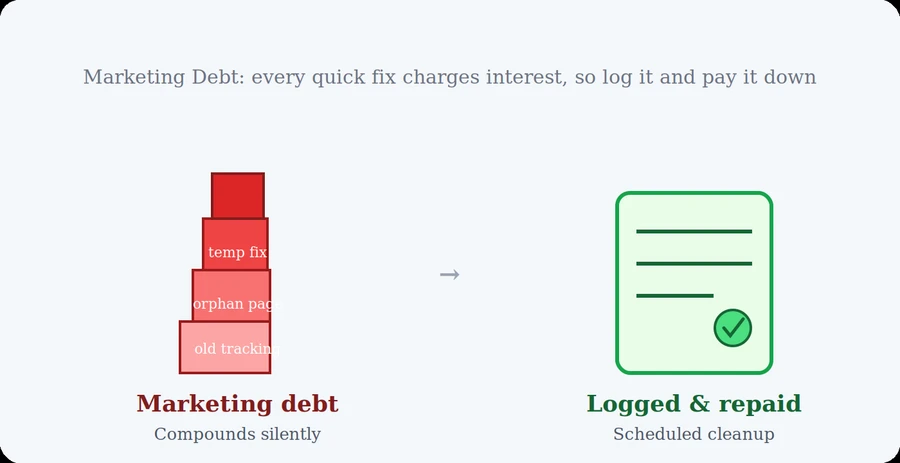
Developers have a name for the shortcuts they take to ship fast: technical debt. You borrow speed today and repay it later, with interest. Marketing has exactly the same phenomenon, but almost nobody names it — so nobody budgets for it. The landing page built in a rush for a campaign that ended eight months ago. The tracking patch someone added “temporarily” in 2023. The naming convention that made sense to one person who has since left the company.
What Is Marketing Debt?
This is Marketing Debt, and it compounds silently. Individually, each shortcut was rational. Collectively, they produce an account nobody fully understands, a website with forty orphaned pages, and reporting that three people interpret three different ways — the same murky measurement problem we described in Tip #8’s Attribution Delusion. Eventually you reach the stage every indebted team knows: you can no longer move quickly, because every new action requires archaeology first.
How to Manage Marketing Debt Before It Compounds
Debt isn’t inherently bad — but unmanaged debt is fatal.
- Log It When You Take It: When you knowingly take a shortcut, write it down with an expiry date. Undocumented debt is the kind that bankrupts you.
- Schedule Repayment: Reserve a recurring slice of capacity — a day a month, a week a quarter — purely for cleanup: dead campaigns, stale pages, broken tracking, obsolete automations. Dead campaigns kept alive out of habit are exactly what we warned about in Tip #9’s Sunk Cost Cemetery — they’re not just an emotional trap, they’re a debt payment you keep deferring.
- Audit at Handover: Every time an account, channel, or role changes hands, treat it as a debt inspection, not just a knowledge transfer. This applies just as much to automations built under the “kill criteria” logic in Tip #16 — a lead-routing rule nobody remembers writing is still debt, even if it’s automated.
Why You Should Audit Debt at Every Handover
The fastest teams aren’t the ones who never take shortcuts. They’re the ones who remember where they buried them. And just like the wasted spend we described in Tip #5’s Leaky Bucket Syndrome, debt you can’t see is debt you can’t patch.
#digital_marketing_strategy_tips
FAQ
Q: How is marketing debt different from just having a messy account?
A: A messy account is the symptom. Marketing debt is the underlying cause — every shortcut is a small, individually reasonable decision that trades short-term speed for long-term clarity. The mess is what debt looks like once it’s compounded for a year without being logged or repaid.
Q: We’re a small team — do we really need to formally “log” every shortcut?
A: You don’t need a formal system, just a visible one — a shared doc, a pinned Slack channel, even a sticky note column on a Trello board. The goal isn’t bureaucracy, it’s making sure the shortcut is remembered by more than one person’s memory, which fades or leaves the company.
Q: How do we prioritize which debt to pay down first when everything feels urgent?
A: Start with debt that blocks decisions, not just debt that looks messy. Broken tracking that makes your numbers unreliable outranks an ugly but functional landing page — the first stops you from knowing what’s working, the second is just cosmetic.
Q: Isn’t scheduling time for cleanup a hard sell when there’s always a new campaign to launch?
A: Frame it the same way you’d frame paying down a credit card: the interest (slower campaigns, unreliable data, onboarding confusion) costs more over a year than the cleanup time does in a single afternoon. A recurring half-day a month is cheaper than a full week of untangling a mess later.
Final Thought
Every shortcut you take today is a loan against your future team’s speed. That’s not a reason to stop taking shortcuts — it’s a reason to write down which ones you took, and when you plan to pay them back.
Let’s Find Out How Much Marketing Debt You’re Carrying
We audit accounts, tracking, and orphaned pages, then build you a repayment plan.