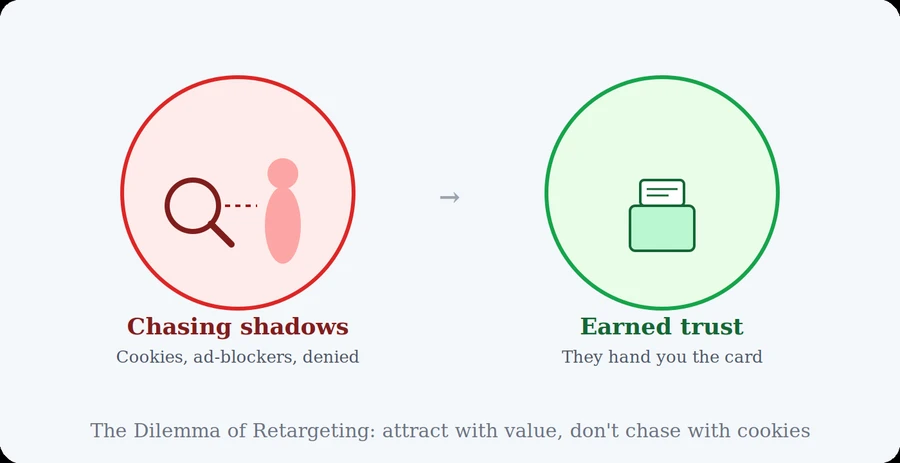
For years, digital marketers have been like clumsy detectives. A prospect would visit our website, and we’d slap a tracking cookie on their digital trench coat. We’d then follow them across the entire internet, popping out from behind every corner, shouting, “Remember us?!” While sometimes effective, the cover has been blown.
What Killed Old-School Retargeting?
Today’s customers have cloaking devices like ad-blockers, and new privacy laws require us to ask for permission to follow them, a request that is often denied. The footprints are fading. This is the same shift we later called out in Tip #11’s Rented Land Delusion — third-party tracking was always rented, and the landlord just changed the locks.
How to Attract Instead of Chase
The era of the clumsy detective is over; it’s time to become the master sleuth. A master sleuth doesn’t follow; they attract. Instead of chasing prospects down digital alleys, they create an irresistible case — a valuable webinar, an insightful e-book, or a must-have checklist — that makes the prospect willingly walk into the detective’s office and hand over their business card.
Why First-Party Data Is Your Direct Line to Customers
The future of retargeting lies not in renting data to follow shadows, but in earning the trust to build your own case file of first-party data, creating a direct line of communication that no browser update can sever. That case file is also what makes real segmentation possible — the “adjustable seat” we described in Tip #13’s Average Customer Fallacy only works once you actually know who your different customers are. And once someone hands you that business card, don’t let the moment go cold — the same urgency from Tip #16’s Speed-to-Lead Leak applies here too.
#digital_marketing_strategy_tips
FAQ
Q: Is old-school cookie-based retargeting completely dead now?
A: Not entirely, but its reach keeps shrinking with every browser update and privacy regulation. Treat it as a fading supplement, not your core strategy going forward — the businesses caught off guard are the ones who never built a first-party alternative.
Q: What makes a lead magnet “irresistible” enough that people actually hand over their info?
A: It has to solve a specific, immediate problem your ideal customer already knows they have — not a generic “download our guide.” The more specific the pain it addresses, the less it feels like a trade and the more it feels like a gift.
Q: We’re a small business — do we need fancy marketing automation to do this?
A: No. A simple email signup form connected to any basic email tool is enough to start. The strategy matters more than the tooling — attract first, worry about sophisticated automation once you have a list worth automating.
Q: How long does it take to build a first-party list large enough to matter?
A: It depends on your traffic and offer, but the compounding starts immediately — even a small, engaged list you own outperforms a much larger rented audience you can’t reliably reach. Start now rather than waiting for the “right” size to begin.
Final Thought
Every cookie you rely on is a permission you can lose overnight. Every email address someone hands you willingly is a permission that’s already been granted — and it’s yours to keep.
Let’s Build You a First-Party Data Engine
We design lead magnets and capture systems that earn permission instead of renting attention.