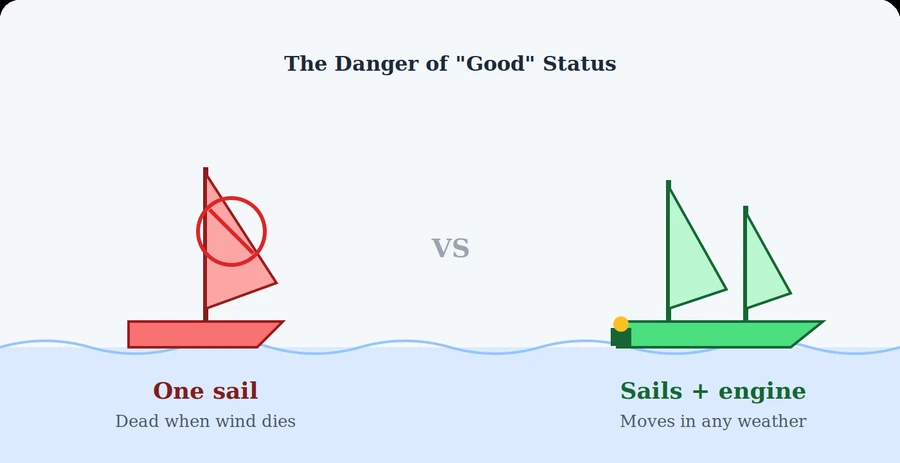
Imagine you’re the captain of a ship, and the wind is perfect. Your sails are full, the current is in your favor, and you’re making record time. In this moment of success, you think, “We’re moving so fast, let’s cut the engine to save fuel.” This is what businesses do when they halt marketing because they’re busy. They mistake temporary, favorable winds — like a surge in word-of-mouth — for a permanent state, failing to realize their engine is what gets them through the inevitable calm.
What Is the Danger of “Good” Status?
The danger isn’t the good season itself — it’s the false confidence it creates. A business riding a temporary wave of referrals or seasonal demand starts to believe that wave is the new normal, and quietly stops the marketing engine that was supposed to carry it through the next calm stretch. By the time the wind dies, the engine has been off long enough that restarting it takes far longer than it would have to simply keep it running.
How to Build a Marketing Engine That Doesn’t Depend on Wind
Now, imagine that same confident captain built his ship with only one, massive sail. It was glorious when the wind was just right, but the moment the wind dies or shifts direction, the ship is dead in the water. Relying on a single marketing platform is the same gamble — the exact risk we detailed in Tip #11’s Rented Land Delusion, where one platform can raise the rent, change the algorithm, or evict you entirely without warning.
Why Relying on One Platform Is a Gamble
A wise captain keeps the engine humming and rigs their ship with multiple sails, oars, and navigation tools. They know the goal isn’t just to enjoy a good day’s wind, but to build a vessel that can reliably reach any destination, in any weather. Even a well-performing channel eventually fades, the same fatigue we described in Tip #7’s Performance Plateau — the engine needs to already be running before that happens, not started in a panic after.
#digital_marketing_strategy_tips
FAQ
Q: We’re genuinely too busy fulfilling orders to keep marketing right now. Isn’t pausing reasonable?
A: Pausing execution during a genuine capacity crunch is different from cutting the budget and strategy entirely. Keep the engine idling — even a reduced, automated presence — so restarting later doesn’t mean rebuilding from zero.
Q: How do I know if my current “good” momentum is a permanent shift or a temporary wind?
A: Ask whether the surge came from something repeatable (a channel you control and can scale) or something situational (a viral moment, a referral spike, a seasonal peak). If you can’t point to a mechanism that reliably reproduces it, treat it as temporary wind, not a new baseline.
Q: We only have budget for one or two channels right now — doesn’t that contradict “multiple sails”?
A: The point isn’t running every channel at once, it’s not being one algorithm change away from zero. Even two smaller, different channels (e.g., one owned like email, one paid like search) get you most of the protection a single dependency lacks.
Q: How do we tell leadership we need to keep spending during a strong quarter?
A: Frame it as insurance, not extra cost: the marketing spend during the good season is what shortens the recovery time during the next slow one. Show them what happened the last time momentum was mistaken for permanence, if that data exists.
Final Thought
The best time to strengthen your marketing engine is exactly when you feel like you don’t need it. By the time the wind proves you wrong, the engine you cut is a lot harder to restart than it would have been to simply leave running.
Let’s Build a Marketing Engine That Never Idles
We diversify your channels so no single algorithm shift or slow season can stall your business.