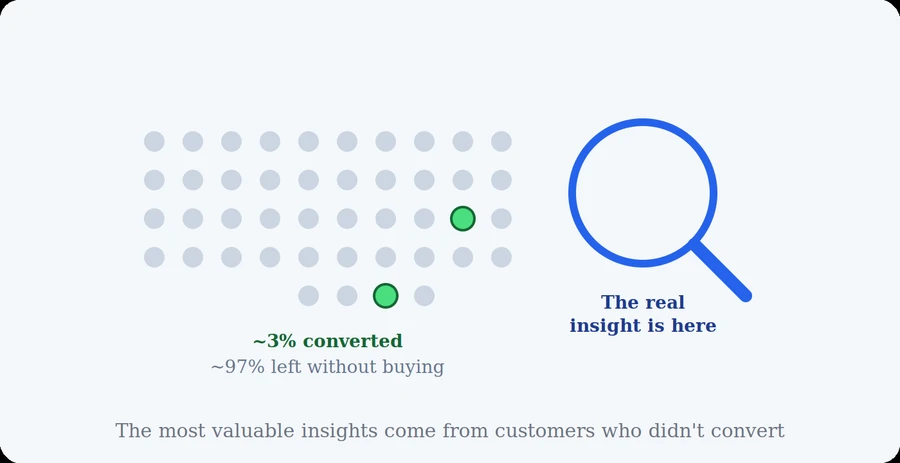
While we often excel at understanding the reasons why our converted customers (~3%) loved our website, it’s crucial to consider the perspective of the remaining majority (~97%) who didn’t.
A Real Example: When the Owner’s Story Wasn’t the Whole Story
I recall a business owner sharing with me, “I’m entirely convinced that the vast array of products listed on my website played a pivotal role in driving customers to visit my physical store and make purchases of my goods.”
I wholeheartedly embraced his viewpoint. However, I also embraced the tracking analytics tools that unequivocally illustrated to me that a significant portion of potential prospects became disoriented amid the overwhelming and chaotic array of products on the website, ultimately leading them to leave. This is the exact confusion a chaotic layout creates that we broke down in Tip #12’s Feature Trap — more listed products felt like more value to the owner, but to the visitor it was more noise standing between them and a decision.
Why You Can’t Rely on Instinct Alone
In general, it’s advisable not to solely depend on the insights provided by business owners. Such insights can sometimes be skewed by cognitive biases, leading to an overemphasis on either positive or negative indicators. Occasionally, astute business owners might even deliberately present you with misleading information to test your expertise.
It is imperative to place strong reliance on meticulous tracking analytics, especially when they originate from diverse sources, encompass statistically significant data, and encompass a range of redundant metrics. This is the same clarity-first discipline we’ve argued for since Tip #14’s Curse of Knowledge — the person closest to the product is often the least reliable narrator of why a stranger actually leaves it. And once you’ve found the real reason in the data, that insight is often the seed of a much bigger opportunity: the specific, underserved gap we described in Tip #15’s Category of One.
#digital_marketing_strategy_tips
FAQ
Q: How do I get insight from customers who left without ever telling us why?
A: Tracking analytics (session recordings, drop-off points, heatmaps) show you where they got stuck even without a word from them. Exit-intent surveys and post-abandonment emails can add the “why” on top of the “where.”
Q: The business owner insists they know their customers best — how do I push back respectfully?
A: Treat their instinct as a hypothesis worth testing, not a fact to accept or reject outright. “That matches what a few customers do — let’s check if it matches what most of them do” keeps the conversation collaborative instead of adversarial.
Q: What counts as “statistically significant” when I don’t have huge traffic?
A: You don’t need thousands of sessions to spot a real pattern — a recurring drop-off point that shows up across weeks and multiple traffic sources is more trustworthy than a single spike from one busy day. Consistency over time matters more than raw volume alone.
Q: What if the data and the owner’s story actually agree?
A: Great — that’s confirmation, not a wasted check. The point isn’t to assume the owner is wrong, it’s to never treat a single person’s read of “why customers buy” as the whole picture until the data backs it up.
Final Thought
The 3% who converted already told you what’s working. The 97% who didn’t are the ones holding the answer to what’s costing you sales — and they’re usually a lot easier to listen to than they look.
Let’s Find Out Why Your Visitors Are Leaving
We dig into your real tracking data to uncover what’s actually costing you conversions.