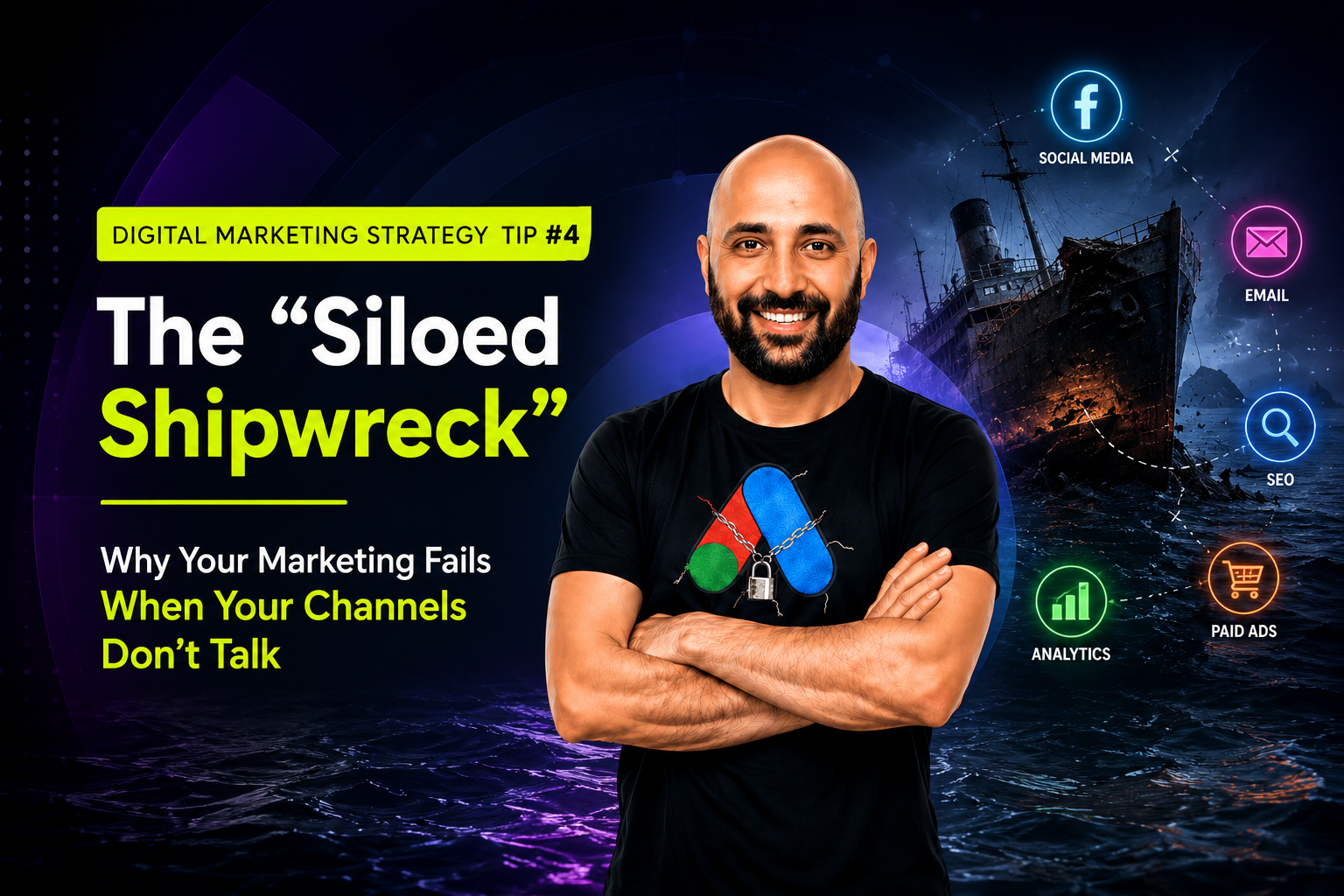
the “Siloed Shipwreck.”:
Why Your Marketing Fails When Your Channels Don’t Talk

When SEO, ads, and email don’t communicate, your marketing ship slowly sinks instead of sailing forward.
Imagine a magnificent ship where the captain, the navigator, and the engineer all refuse to speak to each other.
The navigator is charting a course based on the stars (your SEO team), the engineer is burning fuel at maximum speed
(your Ads team), and the captain is sending messages in a bottle (your Email team).
Each one is technically doing their job, but none of them are aligned on where the ship is going.
This is exactly how many companies run their marketing today. Every channel lives on its own little island:
SEO is chasing rankings, Ads is chasing clicks, Email is chasing open rates, and nobody is sharing what they’re learning.
On the surface, things look busy. Underneath, the result is chaos. This is the “Siloed Shipwreck.”
How Siloed Marketing Sinks Your Results
In a siloed setup, your SEO team discovers a golden keyword that attracts high-intent visitors,
but your Ads team is busy bidding on something completely different. Your Ads campaign brings in hundreds
of leads, but your Email team sends them all the same generic newsletter instead of a targeted nurture
sequence based on what they actually showed interest in.
The result? The customer experiences a disjointed, confusing journey. They see one promise in your ad,
read something slightly different on your landing page, then receive an email that feels like it’s written
for someone else. Your budget isn’t just being spent — it’s fighting itself.
It comes from making your channels work together. Integration is the only way to build a vessel
that actually moves forward in one clear direction.

Turn Your Channels Into a Unified Crew
When your marketing channels talk to each other, they stop competing and start collaborating.
Each one becomes stronger because of the others. Instead of three teams pulling in different directions,
you get a single, aligned growth engine.
1. Let SEO Be the Navigator for Ads
Your SEO team’s data on high-converting organic keywords should be the first place your Ads team looks
when planning new campaigns. If a keyword is already bringing in qualified traffic organically, it’s a strong
candidate for a paid campaign too.
- Use top organic keywords to build search ad campaigns with proven intent.
- Mirror successful SEO page angles in your ad copy and landing pages.
- Protect high-value organic positions with smart, complementary bidding — not random keywords.
This approach reduces guesswork and helps your ads start from a place of known demand rather than pure experimentation.
2. Use Ads as a Real-Time Focus Group for SEO
Your Ads team is constantly running A/B tests on headlines, descriptions, and calls-to-action.
That data is a live, paid focus group — and it’s incredibly valuable for SEO.
- Take the winning ad headlines and use them as inspiration for SEO title tags and meta descriptions.
- Let high-performing ad copy influence on-page headings and hero sections.
- Use ad engagement data to decide which angles and benefits deserve full SEO content clusters.
Instead of guessing which message will resonate in search, you let the performance of your ads guide your SEO content strategy.

Visualizing your channels as one crew, not separate departments, changes how you build campaigns and measure success.
3. Let Email Close the Loop for SEO and Ads
The leads that come from both SEO and Ads can’t just fall into a generic email list.
They should be segmented and nurtured based on the exact topic or offer that brought them in.
- If a user converts on an SEO blog about “scaling Google Ads,” send a sequence focused on advanced ad strategies.
- If someone clicks an ad about “free audit” and signs up, follow up with case studies, data, and a clear next step.
- Use UTM tags and forms to track where each lead came from, then trigger the right email automation.
When email is aligned with channel intent, your nurture flows feel personal, relevant, and timely —
which dramatically increases replies, demos booked, and deals closed.
From Siloed Shipwreck to Integrated Growth Engine
Integration doesn’t mean you need a huge team or complex tools. It starts with a simple mindset shift:
no channel makes decisions alone. SEO should check paid performance insights. Ads should start from SEO wins.
Email should be built around the promises made in both.
When your channels finally talk to each other:
- Your SEO insights lower your ad costs and improve targeting.
- Your ad data sharpens your SEO focus and content priorities.
- Your email marketing quietly closes the deals for both.
Stop letting your departments run their own little islands. Build bridges, share data, and align your messaging.
Your ship doesn’t need more fuel — it needs everyone rowing in the same direction.
Tip #3: Don’t optimize channels in isolation. Optimize the system.
You Can read More about Digital Marketing Tips In Our Social Media https://www.facebook.com/story.php?story_fbid=122149596896874767&id=61576243032359&mibextid=wwXIfr&rdid=tvxn00jIcz7HESFk#